
Cellevat3d® VAX nanofiber microcarriers for viral vaccine production

For booking a product presentation or for ordering, please contact our sales team
Product specification overview
| Approximate surface area (dry) | 53 000 cm²/g |
| Material | Cellulose nanofiber |
| Surface charge | Cationic |
| Average nanofiber diameter | 500nm |
| Animal origin free | Yes |
| Bioreactor | Stirred-tank bioreactors |
| Sterilization procedure | Autoclavation before use |
| Scalability | From lab- to large-scale production |
Cellevat3d® VAX nanofiber microcarriers are specifically optimized for adherent cell lines such as Vero cells, which are widely used in viral vaccine production. These nanofiber microcarriers promote the formation of homogeneous, three-dimensional (3D), cell dense Vero spheroid cultures readily scalable in conventional stirred tank bioreactor systems. Importantly, our cell culture product enables efficient virus propagation and improved functional viral vaccine production titers, offering a scalable and cost-efficient solution to enhance vaccine production. The latest benchmarking and validation projects have shown more than 13-fold increase in viral vaccine titers using Cellevate’s nanofiber product in Vero cell cultures compared to industry-standard microcarriers. More information is described in the Application Note.
Cellevat3d® VAX nanofiber microcarriers are developed and manufactured under a quality system according to ISO 9001 and 21 CFR 820, under strict process controls guaranteeing consistent product performance, document and batch traceability. Every batch conforms to stringent quality control specifications. No animal derived material is used in raw materials or in the manufacture. Cellevate is ISO 9001:2015 certified and has implemented GMP processes for production in clean room.
Summary of benchmarking and validation projects:
More than 13-fold increase in viral vaccine titers using novel nanofiber microcarriers
in Vero cell cultures
Background
Adherent cell-based viral vaccine production traditionally relies on bead-based microcarriers, roller bottles, cell stacks, and fixed-bed bioreactors. While well established, these methods present significant limitations in scalability, cost-efficiency, and labor intensity, particularly when addressing high-volume demands. Moreover, modern vaccine manufacturing is challenged to develop high-quality products at lower costs and within shortened timelines. As a result, there is a growing need for innovative viral vaccine production platforms that increase yields and productivity, reduce process complexity, enhance ease of use and robustness, and support rapid process transfer and scalability.
To overcome these challenges, we have developed a new category of cell growth support made from sustainable, cellulose-derived nanofibers fully compatible with stirred-tank bioreactors and enabling seamless process transfer and scale-up in existing production facilities. Our latest product, Cellevat3d® VAX nanofiber microcarriers, is specifically optimized for adherent cell lines such as Vero cells, which are widely used in viral vaccine production. These nanofiber microcarriers provide a large surface area for cell attachment and controlled formation of three-dimensional (3D) spheroids, resulting in dense, viable cell cultures ideal for efficient virus propagation and production. Altogether, Cellevat3d® nanofiber microcarriers offer a sustainable and scalable solution that significantly enhances productivity in viral vaccine manufacturing.
Results
1. Scale-up of homogenous, reproducible, high-density 3D spheroid cultures of Vero cells in a stirred-tank bioreactor
Data demonstrated that Vero cells grown on nanofiber microcarriers formed homogeneous and reproducible 3D spheroid cultures. The cultures were successfully scaled up in a stirred-tank bioreactor, showing consistent cell growth comparable to that achieved in a spinner flask, reaching viable cell densities of 2.3×10⁶ cells/mL after 72h of cultivation. The cell growth rates were also comparable to those observed in 2D culture formats, as shown by similar fold changes relative to the seeding density after 72h (Figure 1A-D).


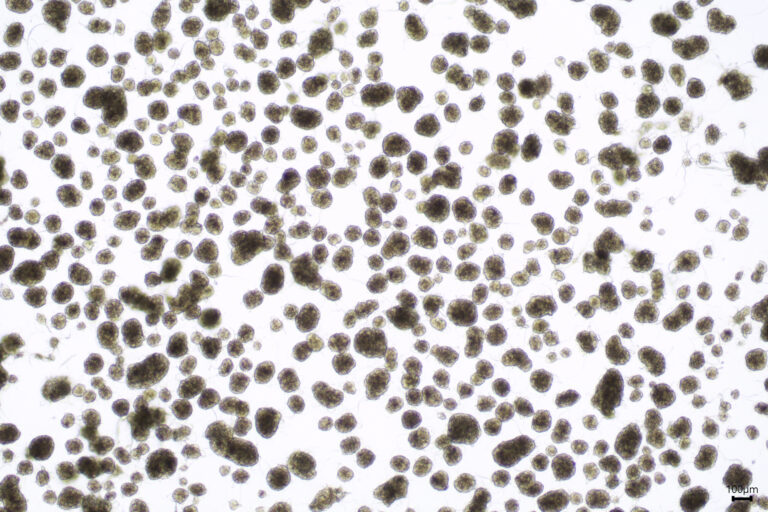
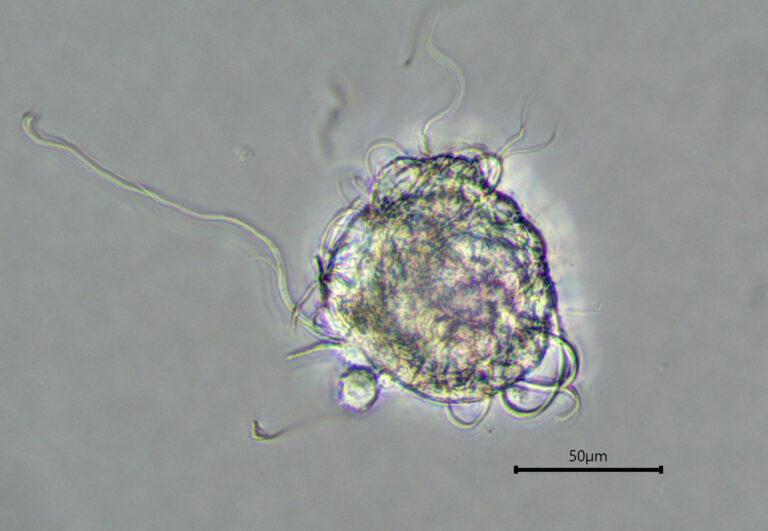
Figure 1. Vero cell growth using Cellevat3d® VAX nanofiber microcarriers. A Reproducible and consistent cell growth curves achieved in spinner flask and across two consecutive bioreactor runs (Applikon miniBio), with an average cell viability of 99% maintained throughout the culture. Viable cell densities (VCD) reached up to 2.3×10⁶ cells/mL. B Fold change relative to seeding density for nanofiber cultures and 2D cell cultures after 72h of cell growth. Brightfield microscope images of 3D spheroids at C 4× magnification and D 40× magnification. Data are presented as mean ± SEM from biological replicates.
2. Benchmarking study demonstrated 13.5-fold higher infectious enterovirus A71 titers using Cellevat3d® VAX nanofiber microcarriers as compared to industry-standard microcarriers
In a benchmarking study, EV71 production with Vero cells cultured on nanofiber microcarriers showed consistently higher infectious virus titers than industry-standard bead-based microcarriers across all harvest time points, including 8–11 days post-infection (DPI) (Figure 2A).
The nanofiber microcarrier culture yielded a maximum infectious virus titer of 1.60×10⁶ TCID50/mL and a cell-specific virus yield (CSVY) of 1.86 TCID50/cell at 10 DPI, whereas industry-standard microcarrier culture reached at most 1.19×10⁵ TCID50/mL and 0.07 TCID50/cell at 9 DPI (Figure 2B and Figure 2C).
A comparison of peak infectious titers demonstrated a 13.5-fold increase when using nanofiber microcarriers, along with a 26-fold improvement in CSVY. These findings highlight the potential of Cellevat3d® VAX nanofiber microcarriers to significantly enhance production efficiency in viral vaccine manufacturing.
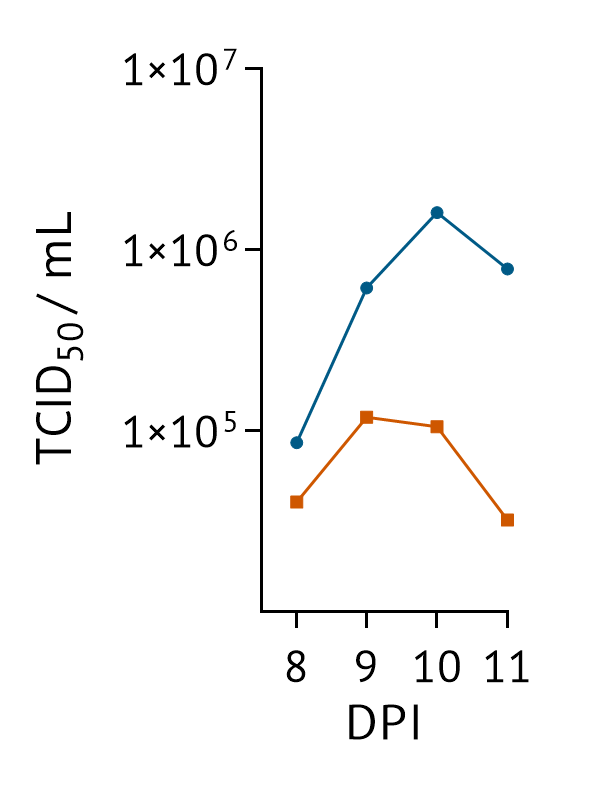


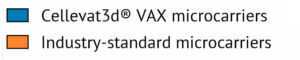
Figure 2. Benchmarking study results. A Viral production curves across various harvest timepoints showing infectious EV71 titers (TCID₅₀/mL) from Vero cells cultured on nanofiber microcarriers and industry-standard bead-based microcarriers. B Mean peak titers from 3 technical replicates showed 13.5-fold higher infectious EV71 titer when using nanofiber microcarriers C Cell-specific virus yield comparing productivity of nanofiber microcarrier cultures (10 DPI) and industry-standard microcarrier cultures (9 DPI) showed 26-fold improvement in infectious titer per cell when using nanofiber microcarriers. Data are presented as mean ± SEM.
3. 11.4-fold higher infectious enterovirus (non-disclosed) titers using Cellevat3d® nanofiber microcarriers
Benchmarking data generated by Intravacc, demonstrated that HEK293T spheroid cultures grown on nanofiber microcarriers produced 11.4-fold higher infectious enterovirus titers (5.01×10⁶ TCID50/mL) compared to industry-standard microcarrier cultures (4.41×10⁵ TCID50/mL) (Figure 3A). Additionally, the nanofiber spheroid cultures achieved a CSVY of 6.26 TCID50/cell, representing a 17-fold increase over industry-standard microcarrier cultures, which yielded 0.37 TCID50/cell (Figure 3B).
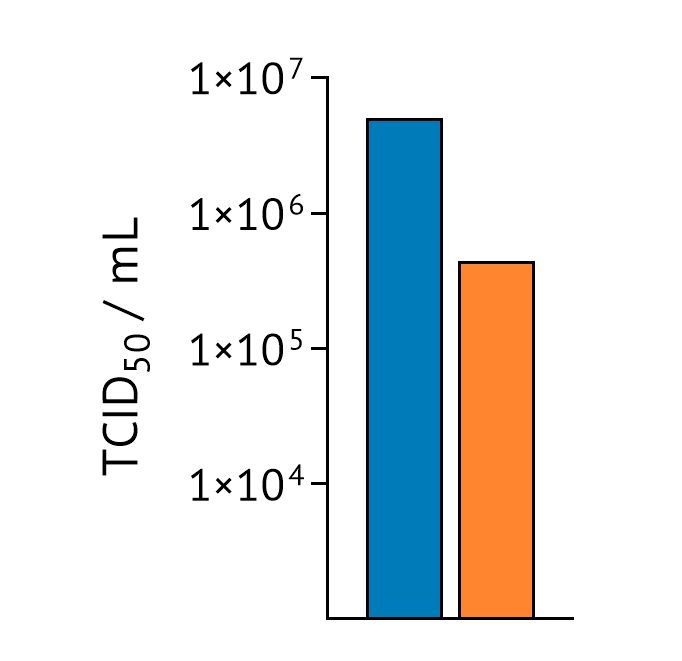
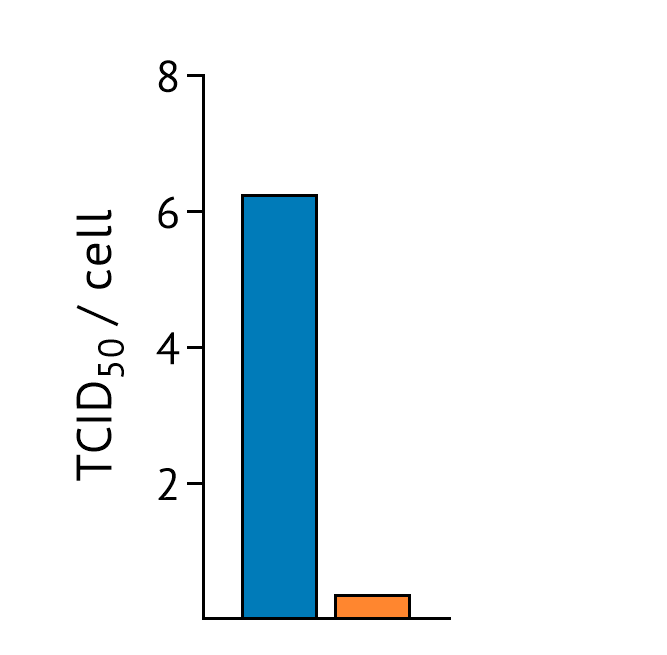

Figure 3. HEK293T cells grown on nanofiber microcarriers and industry-standard microcarriers in replicate flasks generating A 11.4-fold higher infectious enterovirus titers and B 17-fold increase in cell-specific virus yield when using nanofiber microcarriers. Data are shown as mean.
Conclusions
Using our novel Cellevat3d® VAX nanofiber product, Vero cell cultures formed homogeneous, reproducible, high density 3D spheroid cultures that promoted efficient propagation and production of high-quality infectious viruses. Benchmarking studies demonstrated that the nanofiber-based microcarrier cultures consistently achieved over a 10-fold increase in infectious virus titer and functional volumetric productivity compared to industry-standard microcarrier processes, across two different cell lines and two distinct viral vaccines, showing the versatility and robustness of the products. Cellevat3d® nanofiber microcarriers can be readily integrated into existing stirred-tank bioreactors and process development workflows, offering a scalable and cost-efficient solution to enhance vaccine production.